Zcash (ZEC) — Buy: Financial Privacy Could Drive the Next Growth Cycle
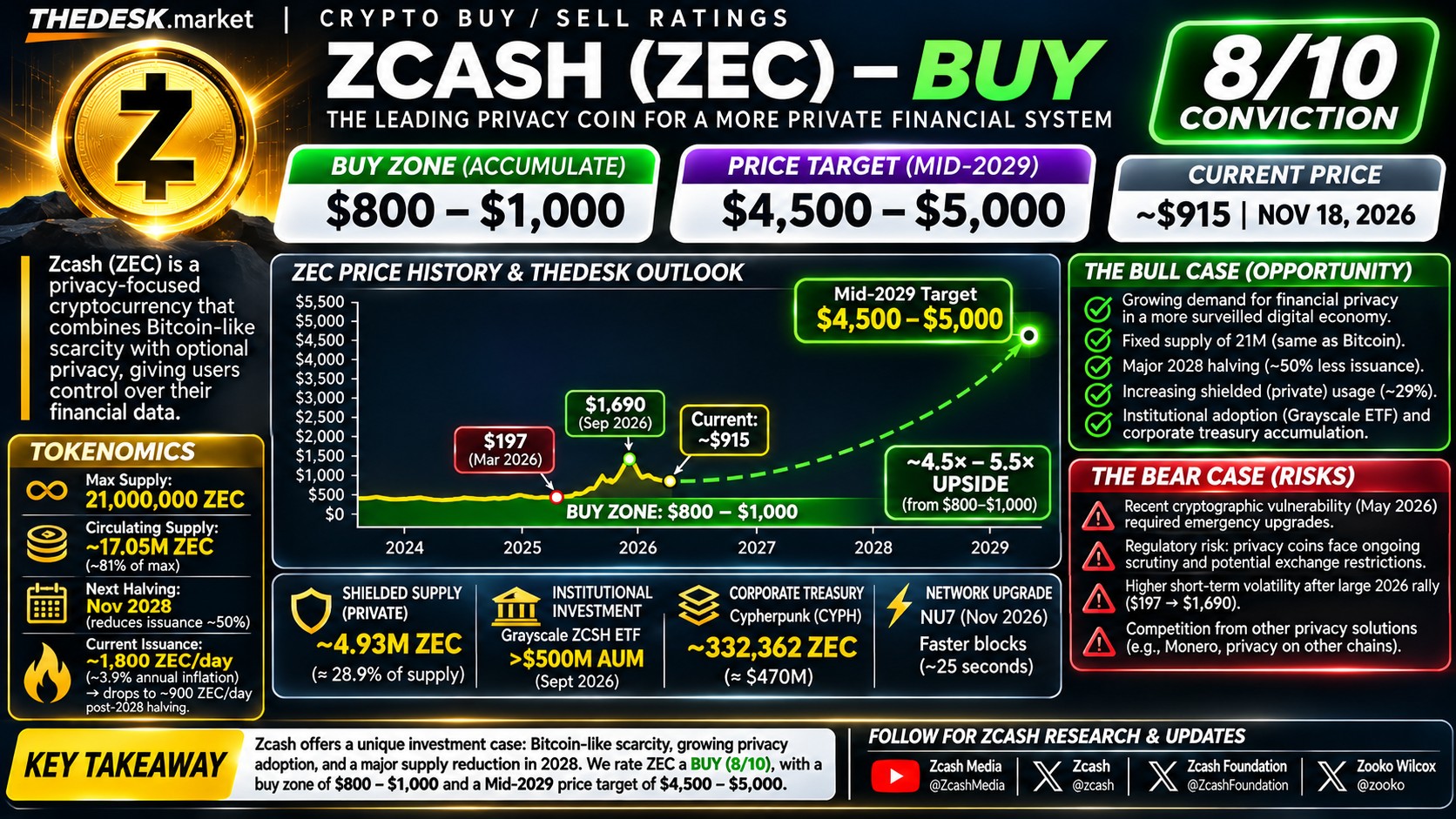
The Desk rates Zcash Buy with 8/10 conviction, a preferred $800–$1,000 accumulation range, and a $4,500–$5,000 mid-2029 scenario target. The thesis rests on privacy adoption and fixed supply, balanced against security, regulatory and volatility risks.
By The Desk Research · Published
- Rating
- Buy
- Conviction
- 8/10 — editorial confidence, not a probability or guarantee
- Buy zone
- $800–$1,000
- Long-term target
- $4,500–$5,000
- Target date
- Mid-2029
- Sell signal
- Reassess below $750
Investment Outlook: Privacy as Financial Infrastructure
Zcash is a proof-of-work cryptocurrency designed to combine Bitcoin-like supply limits with optional financial privacy. Its shielded transactions use zero-knowledge cryptography to conceal transaction details while still allowing the network to verify that transfers follow protocol rules. Selective disclosure lets users share relevant information when needed.
The investment thesis is that more financial activity moving to public blockchains may increase demand for confidentiality. Businesses may not want competitors observing payment flows; individuals may want privacy around savings and spending; and institutions may need to protect client information. The Desk sees privacy as a potentially important part of digital financial infrastructure, especially as automated tools make public-chain analysis more capable.
The supplied November 18, 2026 reference price is approximately $915. The Desk's graphic sets a BUY rating with 8/10 conviction, an $800–$1,000 preferred accumulation range and a $4,500–$5,000 mid-2029 target. The target is a high-growth scenario and depends on privacy adoption, continued technical development and stronger market demand.
ZEC remains highly volatile, and the privacy model adds technical and regulatory complexity. The target would imply a circulating market value approaching $100 billion under the supplied issuance assumptions, so scarcity alone is not enough; the network would need sustained adoption and investor confidence.
Shielded Transactions and Growing Privacy Use
Unlike a fully transparent blockchain, Zcash gives users the option to move value through shielded pools. The protocol can validate a shielded transaction without exposing the sender, recipient and amount publicly. Users can also selectively disclose transaction information, a feature that may help when documentation or compliance is required.
The supplied research estimates that approximately 4.93 million ZEC were held across shielded pools on November 18, 2026—about 28.9% of issued supply. It also references 2026 Grayscale research describing growth in shielded activity. These figures suggest that privacy use is an active part of the network, not only an investment narrative.
Shielded balances are not necessarily locked, inaccessible or permanently removed from the market. They should not be treated as a guaranteed reduction in liquid supply. The more useful adoption signal is whether shielded usage continues to grow and supports durable demand for the network.
Privacy technology alone is not sufficient. Users need secure, convenient wallets, reliable infrastructure and clear ways to use the network. Better cryptography and usability could support adoption, but a difficult user experience or a loss of trust could limit it.
Fixed Supply and the November 2028 Halving
Zcash has a maximum supply of 21 million ZEC, matching Bitcoin's cap. The supplied November 2026 estimate puts issued supply near 17.05 million coins, roughly 81% of the maximum. A common supply limit does not give Zcash the same monetary premium, liquidity or institutional acceptance as Bitcoin; those are separate advantages Bitcoin has built over time.
Following the November 2024 halving, the report estimates current issuance at about 1,800 ZEC per day, including mining rewards and development allocations, or approximately 3.9% annualized issuance at current supply. The next halving is expected in November 2028 and should reduce the issuance rate by roughly half, to around 900 ZEC per day under the described schedule.
The lower issuance could improve supply dynamics if demand remains steady or grows. By mid-2029, the report estimates about 18.5 million ZEC could be circulating. A halving does not guarantee a price increase: market demand, liquidity, adoption and investor sentiment remain decisive.
Institutional Interest and Zcash Development
The supplied material describes several institutional developments during 2026. Grayscale launched a Zcash investment product under ticker ZCSH on NYSE Arca in August and the report says assets under management exceeded $500 million in September. Cypherpunk Technologies (NASDAQ: CYPH) reported approximately 332,362 ZEC holdings at September 30, valued around $470 million at quarter-end prices, and pursued ZEC treasury and mining activity.
These developments may broaden access and signal that some investors are considering privacy-focused digital assets. They also introduce concentration risk: funds and corporate treasuries can become potential sources of selling if mandates or market conditions change. Institutional ownership is not proof of broad adoption or a permanent source of demand.
The supplied research says Zcash activated its NU7 upgrade on November 5, 2026, reducing targeted block times from about 75 seconds to 25 seconds, and describes continuing work on shielded wallets and infrastructure. It also notes ZODL's development of wallet and protocol software, alongside work from Shielded Labs, the Zcash Foundation and other teams. Faster block production and better tools can help, but improvements still need to translate into secure, usable products.
Security and Regulation Need Close Attention
The most serious concern in the supplied research is a May 2026 vulnerability affecting the Orchard shielded pool. It says the flaw could theoretically have allowed counterfeit ZEC creation and that developers responded with emergency measures and subsequent upgrades, including Ironwood, which introduced another shielded pool and restricted activity in the affected system.
The report says there was no publicly established confirmation that the vulnerability was exploited. Because shielded systems limit what can be observed externally, it may be difficult to rule out historical exploitation conclusively. This episode demonstrates the importance of independent security work, careful upgrades and transparent communication; confidence in cryptography is essential to the investment thesis.
Privacy-focused coins also face regulatory uncertainty. Some exchanges have restricted support for privacy assets, and future rules could affect their availability or use. The supplied report says the Zcash Foundation announced in January 2026 that the SEC had concluded its investigation without recommending enforcement, and that the later investment-product launch improved regulated access. These events do not remove broader policy or listing risks.
These risks cap conviction at 8/10 despite the BUY rating. A renewed security issue, loss of exchange access, or regulation that materially restricts ordinary use could undermine both adoption and valuation.
Why $800–$1,000 Is the Preferred Buy Zone
ZEC rose from approximately $197 in March 2026 to around $1,690 in September before correcting to the supplied November 18 reference near $915. The sharp move highlights both strong demand for the privacy narrative and the asset's substantial volatility.
The $800–$1,000 range includes the report's estimated 200-day moving average near $805 as of November 18. That average is a technical reference, not guaranteed support. The current ~$915 figure is a historical snapshot from the supplied material, not a live quote.
The Desk prefers gradual accumulation within the range rather than trying to call an exact bottom. A sustained move below $750 would warrant reassessing the technical outlook; a break below $600 could signal more significant deterioration in investor demand. Those levels are review signals, not automatic trade instructions.
From $800–$1,000, the $4,500–$5,000 target equates to roughly 4.5x–6.25x price multiples before fees, taxes or any change in assumptions. That potential comes with high risk and should not be read as a promised return.
Mid-2029 Target: $4,500–$5,000
The Desk's mid-2029 target assumes financial privacy becomes a larger crypto-market theme; shielded use expands among individuals, businesses and institutions; institutional access continues; and the November 2028 halving reduces new issuance. Continued improvements in cryptographic security, transaction speed, wallets and network infrastructure are also important.
The supplied estimate of 18.5 million circulating ZEC by mid-2029 would put the $4,500 target near an $83 billion circulating market value and $5,000 near $93 billion. For comparison, the material says Zcash approached a $29 billion market value during the September 2026 rally. Reaching the target therefore requires a major expansion beyond already elevated levels.
The forecast is aggressive. The next halving can reduce new supply, but demand must grow enough to support the implied valuation. A fixed maximum supply is not a substitute for adoption, security confidence, liquidity or a durable market for private transactions.
The Bottom Line
Zcash offers a differentiated mix of optional financial privacy, a 21 million supply cap, declining issuance after its scheduled halving and growing institutional attention. If private transactions become a widely used feature of blockchain finance, ZEC could benefit from a stronger use case than speculation alone.
The counterarguments are material: a recent cryptographic vulnerability, regulatory uncertainty, exchange restrictions, intense price volatility and a target that implies an approximately $83–$93 billion circulating market value. Shielded balances are not necessarily unavailable, and institutional holdings can be concentrated or change direction.
The Desk's selected rating is BUY with 8/10 conviction, a preferred $800–$1,000 accumulation range and a $4,500–$5,000 mid-2029 scenario target. This is an editorial view based on the supplied research, not individualized investment advice, a guarantee or an instruction to trade.
Key risks
- The May 2026 Orchard-pool vulnerability raises cryptographic security and confidence concerns; the supplied research says exploitation was not publicly established.
- Privacy-focused cryptocurrencies may face exchange restrictions or new regulatory limits.
- The ZEC price has been extremely volatile, including a rapid 2026 rally and correction.
- The $4,500–$5,000 target implies a very large market value and requires substantial growth in adoption and demand.
- A 21 million supply cap and scheduled halving do not guarantee appreciation or Bitcoin-like monetary acceptance.
- Shielded balances are not necessarily locked or removed from circulating supply.
- Large fund or corporate holdings could add selling pressure if investor strategies change.
What would change our view
- Reassess the technical outlook after a sustained move below $750; a break below $600 would materially weaken the demand picture.
- Review security assumptions after any material cryptographic disclosure, exploit confirmation, emergency change or delayed upgrade.
- Track shielded-pool adoption while avoiding the assumption that shielded ZEC is permanently illiquid.
- Revisit the thesis if exchange access, regulatory treatment or institutional-product availability changes.
- Review the $4,500–$5,000 target if issuance, halving timing, circulating supply or privacy adoption differs materially from the supplied assumptions.
ZEC creators & analysts to follow
Independent third-party commentary. The Desk does not endorse individual creators or their views.
YouTube
X
Rating history
- — Buy, 8/10. Initial coverage. Preferred accumulation range $800–$1,000; $4,500–$5,000 mid-2029 scenario target.
Editorial opinion, not personalised investment advice. Price targets are forecasts and may not be reached.