UNUS SED LEO (LEO) — Hold: Exchange Buybacks and Bitcoin Recovery Potential
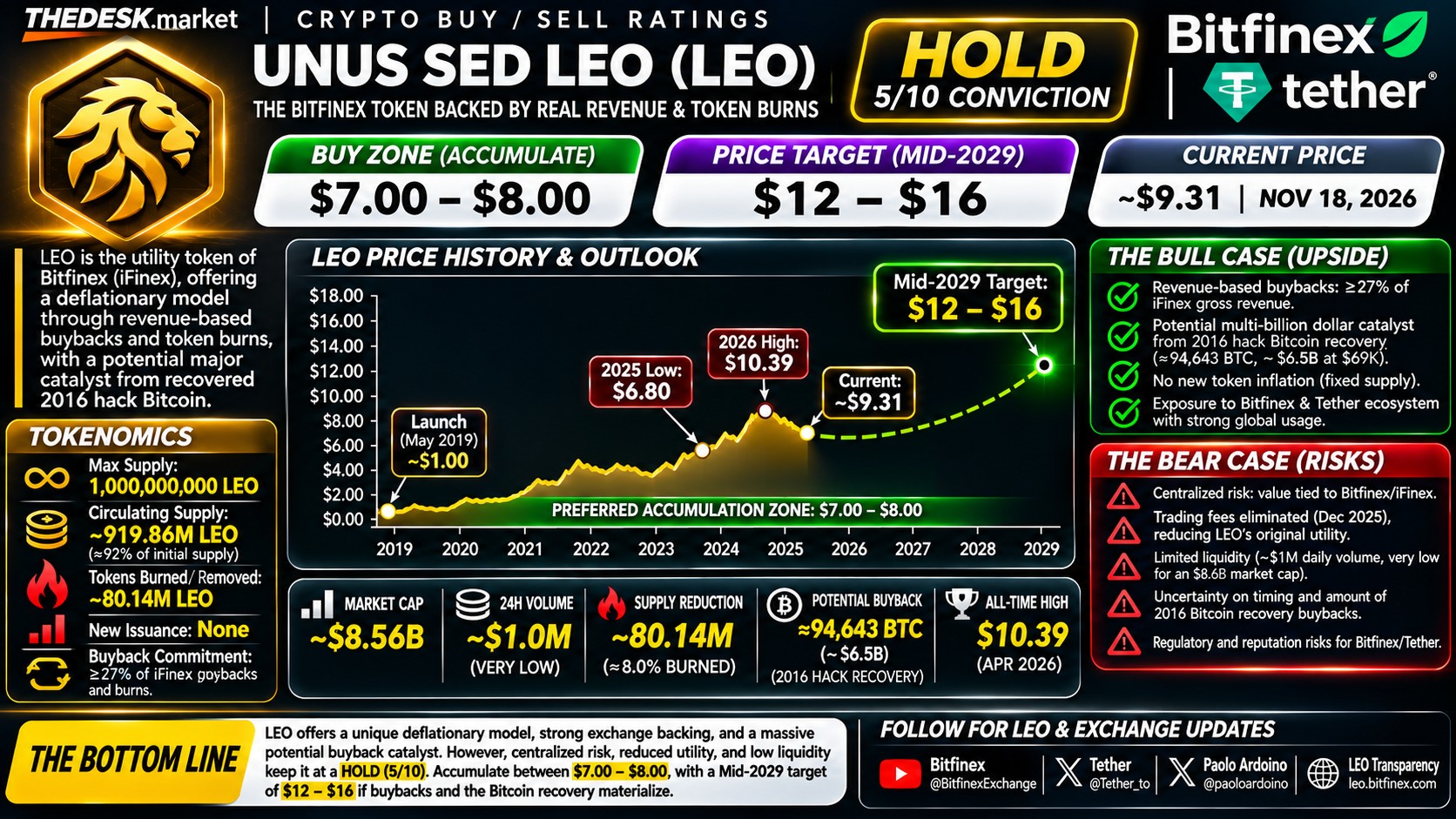
The Desk rates LEO Hold with 5/10 conviction, preferring $7–$8 for accumulation and setting a $12–$16 mid-2029 scenario target. Buybacks and potential proceeds from Bitfinex's 2016 hack recovery are catalysts, but their timing and size remain uncertain.
By The Desk Research · Published
- Rating
- Hold
- Conviction
- 5/10 — editorial confidence, not a probability or guarantee
- Buy zone
- $7.00–$8.00
- Long-term target
- $12–$16
- Target date
- Mid-2029
- Sell signal
- Reassess below $6.80
Investment Overview: An Exchange Token With Company-Specific Drivers
UNUS SED LEO is the utility token issued by iFinex, the parent company of Bitfinex. Unlike Bitcoin, Ethereum or Solana, LEO does not operate a major independent blockchain or broad decentralized-finance ecosystem. Its investment case is tied primarily to Bitfinex and iFinex: token-holder benefits, a recurring repurchase-and-burn program, and a potential Bitcoin recovery catalyst connected to the exchange's 2016 security breach.
The supplied research snapshot places LEO near $9.31 on November 18, 2026, with an estimated market capitalization of approximately $8.6 billion and daily trading volume around $1 million. It reports roughly 919.86 million tokens remaining from the initial one billion. These are dated figures, not live market data.
The Desk rates LEO Hold with 5/10 conviction, preferring an accumulation range of $7–$8 and setting a $12–$16 mid-2029 scenario target. A fixed original issuance and repurchases may support supply reduction, but the pace of burns has been modest and the largest possible catalyst remains difficult to quantify.
LEO is not equity in Bitfinex or Tether. Holders do not receive company ownership rights or corporate dividends. The token's value depends on its utility, iFinex's ability and willingness to meet its commitments, market demand and the financial condition of a concentrated issuer ecosystem.
The Repurchase-and-Burn Mechanism
Under the original LEO whitepaper, iFinex committed to use an amount equivalent to at least 27% of its consolidated monthly gross revenue to repurchase LEO at market prices. The repurchased tokens are intended to be removed from commercial circulation, with the stated commitment continuing until none remain in commercial circulation.
The supplied November 2026 snapshot reports approximately 919.86 million LEO remaining from the original one billion, implying about 80.14 million tokens have been redeemed or burned—roughly 8% of initial supply over more than seven years. It also estimates that about 2.5 million tokens were removed over the preceding year, approximately 0.3% of reported circulation.
The mechanism creates a link between iFinex's business activity and potential LEO supply reduction. However, the historical pace matters: a buyback commitment does not by itself imply rapid deflation or an imminent price increase. A substantial acceleration would be needed to change the supply picture materially.
The original whitepaper also describes a separate commitment related to eligible proceeds from the 2016 Bitfinex hack recovery. These are issuer commitments and depend on the stated terms, financial results, legal obligations and actual recovery. They are not equivalent to token-holder ownership or a guaranteed redemption value.
The 2016 Bitcoin Recovery: A Potential, Not Assured, Catalyst
The supplied research says approximately 119,755 BTC were stolen from Bitfinex in its 2016 security breach and that U.S. authorities later recovered a substantial amount. It describes federal proceedings concerning the possible return of approximately 94,643 BTC to Bitfinex through restitution.
At the report's reference Bitcoin price near $69,000, 94,643 BTC would be worth approximately $6.5 billion. Under LEO's original terms, iFinex committed to use at least 80% of eligible net proceeds from the recovery to repurchase and burn LEO within 18 months after receiving those proceeds. Relevant deductions and obligations—including Recovery Right Token claims—affect what qualifies as eligible proceeds.
The size of any LEO buyback cannot be inferred from the headline value of the recovered Bitcoin. The timing, final proceeds, deductions, claims and implementation all matter. Bitcoin's market value can also change substantially before a recovery is completed.
If large eligible proceeds are received and repurchases occur as described, the buying could be meaningful relative to the supplied estimate of roughly $1 million in daily LEO trading volume. The event remains difficult to forecast and should be treated as optional upside rather than the base case.
Utility and Exchange Dependence
LEO's original utility included trading discounts, withdrawal benefits and services across the Bitfinex ecosystem. The supplied report says the elimination of Bitfinex trading fees in December 2025 weakened one of those benefits and reduced the token's original utility proposition.
This concentration is a defining risk. LEO depends heavily on one privately operated exchange and its parent company, rather than demand distributed across independent applications and users. A change to exchange services, iFinex revenue, token benefits or confidence in the company could affect the investment case directly.
The token's supply-reduction mechanism and potential recovery proceeds are also controlled by issuer commitments. Investors need to distinguish those commitments from enforceable ownership rights, dividends or a guaranteed share of company assets.
Why $7–$8 Is the Preferred Accumulation Range
The Desk prefers $7–$8 for accumulation. The supplied historical data show LEO trading near $6.80 during 2025 and 2026, while the November 18, 2026 snapshot is approximately $9.31 and the graphic marks a 2026 high near $10.39.
The range is a valuation-based entry preference intended to provide more compensation for low liquidity and company-specific risks. It is not a guaranteed technical floor. The report does not recommend aggressive purchases near the $9.31 reference simply because LEO has been relatively stable.
A move below $6.80 is a reason to review the thesis, not an automatic stop-loss. Investors would need to reassess Bitfinex's financial condition, the pace of repurchases, the status of recovery proceedings and LEO utility before treating a lower price as an opportunity.
Mid-2029 Target: $12–$16
The Desk's mid-2029 scenario target is $12–$16. The lower end assumes continued operation of the exchange and gradual supply reduction; the upper end assumes stronger demand, confidence in iFinex and meaningful progress on recovery-related repurchases.
At approximately 920 million circulating LEO, the target range would imply a market capitalization of roughly $11–$15 billion before accounting for future burns. The supplied analysis estimates 29%–72% appreciation from the November 2026 reference price, or roughly 50%–129% for purchases in the $7–$8 range. Those comparisons exclude fees, taxes and changes in supply.
This upside is meaningful but comparatively modest against some other crypto scenarios in The Desk's coverage. LEO could outperform the range if recovery-related buybacks are exceptionally large; delays, less eligible proceeds, weaker exchange revenue or lost confidence could produce materially lower prices.
LEO's outlook depends unusually heavily on company-specific developments rather than only on a broad four-year crypto cycle. The target is an editorial scenario, not a consensus forecast or guaranteed return.
The Bottom Line
LEO has a distinct structure: a fixed original issuance, an ongoing iFinex repurchase-and-burn commitment and potential additional buybacks linked to eligible proceeds from the 2016 Bitfinex hack recovery. The token has also shown relative price resilience during parts of the broader market downturn.
That resilience should not be confused with low risk. The supplied trading-volume estimate is thin relative to the token's market capitalization; utility is concentrated in Bitfinex; the exchange-fee change weakened the original benefits; and the amount and timing of recovery-related repurchases remain uncertain.
The Desk rates LEO Hold with 5/10 conviction, prefers $7–$8 for accumulation and sets a $12–$16 mid-2029 scenario target. This is an editorial assessment, not a claim on Bitfinex or Tether, individualized financial advice or a guaranteed outcome.
Key risks
- LEO is highly dependent on Bitfinex and iFinex, with centralized issuer and counterparty exposure.
- Trading liquidity is low relative to the reported market capitalization, which can magnify price moves and make large trades difficult.
- The 2016 Bitcoin recovery's timing, eligible proceeds and deductions are uncertain; the headline value is not the amount available for LEO repurchases.
- The repurchase-and-burn mechanism has reduced supply gradually; an acceleration is not assured.
- The elimination of Bitfinex trading fees weakened part of the token's original utility proposition.
- LEO is not equity in Bitfinex or Tether and does not confer company ownership or dividends.
- Regulatory, reputational or financial issues affecting Bitfinex, iFinex or related entities could materially affect the token.
What would change our view
- Reassess if LEO sustains a move below the historical $6.80 reference or if the $7–$8 accumulation assumptions no longer hold.
- Track the transparency portal's reported monthly burns against the original repurchase commitment.
- Review legal proceedings, Recovery Right Token claims and the amount and timing of any eligible proceeds from the 2016 breach recovery.
- Revisit the thesis if Bitfinex changes LEO benefits, exchange operations or its financial condition.
- Review liquidity and trading volume before treating market capitalization as an indication of readily available exit liquidity.
LEO creators & analysts to follow
Independent third-party commentary. The Desk does not endorse individual creators or their views.
YouTube
X
Rating history
- — Hold, 5/10. Initial coverage. Preferred accumulation range $7–$8; $12–$16 mid-2029 scenario target.
Editorial opinion, not personalised investment advice. Price targets are forecasts and may not be reached.