TRON (TRX) — Hold: A Stablecoin Powerhouse With Significant Founder Risk
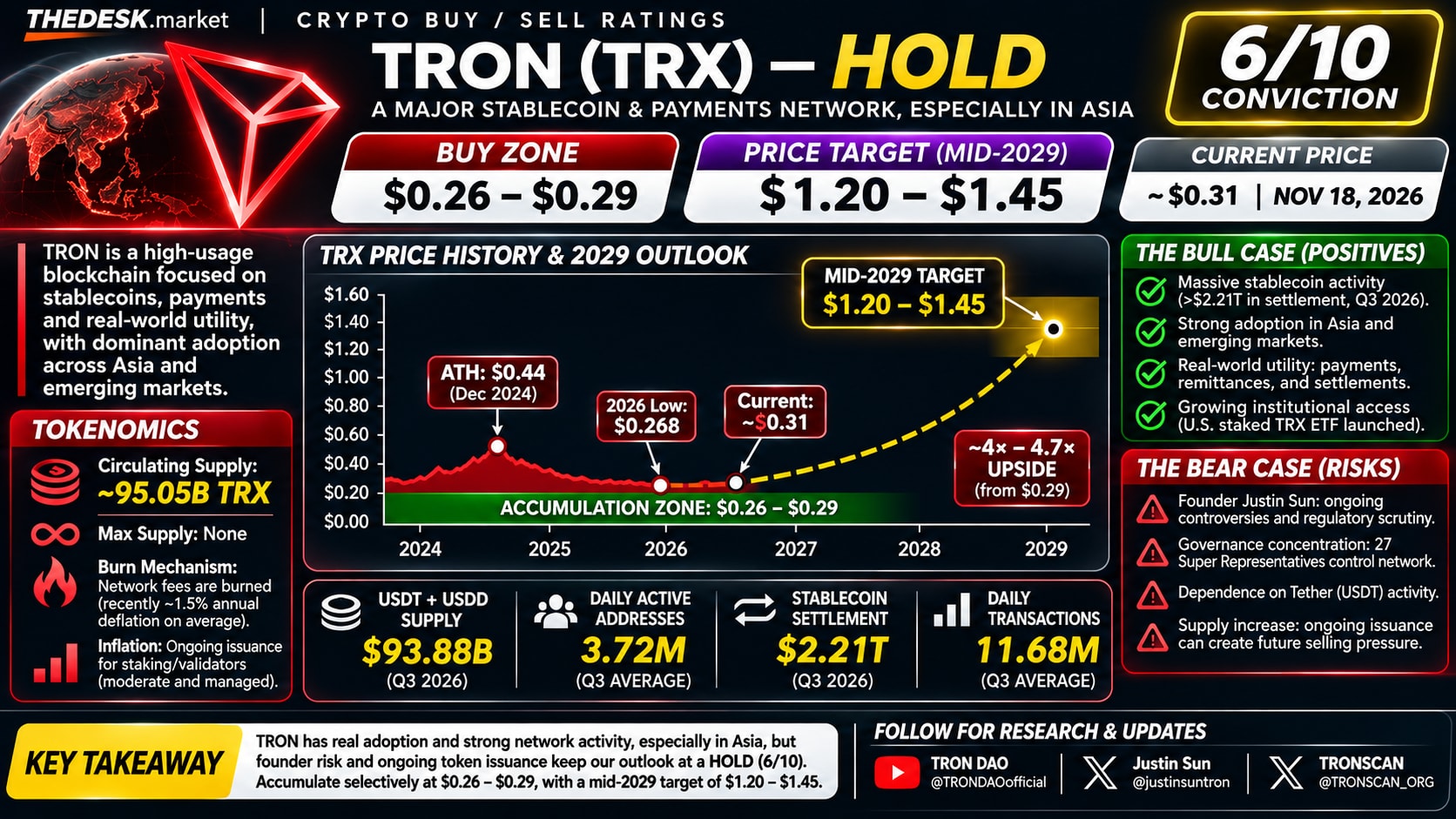
The Desk rates TRON Hold with 6/10 conviction, a preferred $0.26–$0.29 buy zone, and a $1.20–$1.45 long-term target for mid-2029.
By The Desk Research · Published
- Rating
- Hold
- Conviction
- 6/10 — editorial confidence, not a probability or guarantee
- Buy zone
- $0.26–$0.29
- Long-term target
- $1.20–$1.45
- Target date
- Mid-2029
- Sell signal
- Reassess below $0.26
Investment Outlook
TRON is one of crypto's most widely used blockchain networks, though it receives less attention from many Western investors than Ethereum and Solana. Its practical proposition is simple: transfer digital dollars quickly and at relatively low cost.
The network has become a major settlement rail for Tether's USDT stablecoin, with particularly strong adoption across Asia and emerging markets. Unlike projects whose valuations depend mostly on future promises, TRON already handles large volumes of financial transactions.
The supplied Q3 2026 analysis reports $93.88 billion in USDT and USDD supply, $2.21 trillion in quarterly stablecoin settlement, approximately 3.72 million daily active addresses, and an average of 11.68 million transactions per day. It also reports around 18 million monthly active addresses. Addresses are not the same as unique people: one user, exchange or automated service may control many.
This usage could position TRON to benefit from the expansion of stablecoin payments and blockchain-based financial services. But governance concerns, founder-related risk and uncertainty about how network activity creates demand for TRX temper the investment case. The Desk rating is HOLD with 6/10 conviction.
A Large Stablecoin and Payments Network
TRON's strongest advantage is its existing role in global stablecoin transfers. Its liquidity, exchange connections and low-cost transactions have made USDT on TRON a familiar way to move dollars in multiple markets.
The supplied research cites Arkham Intelligence's December 2025 analysis, which identified Asia as the largest regional concentration of TRON stablecoin activity, with roughly $341 billion in annual volume associated with the region. The network also has usage in Latin America and other emerging markets.
In places where access to U.S. dollars, international transfers and traditional banking can be costly, dollar stablecoins may serve practical needs. Adoption across exchanges and payment providers can reinforce a network effect as more users, businesses and services support the same settlement system.
The Desk sees stablecoin growth as a meaningful long-term opportunity, but raw transfer volume alone is not enough to establish that TRX's value will rise proportionally.
TRON's Tokenomics: Burns Offset Issuance—Sometimes
TRON launched with approximately 100 billion TRX and has no fixed maximum supply. New tokens are issued through block-production and voting rewards. At the same time, some network transaction fees are paid by burning TRX, permanently removing it from supply.
Public company disclosures cited in the supplied research indicate TRX supply declined by approximately 1.5% per year on average from January 2022 through July 2026. That history compares favorably with assets experiencing persistent supply growth, but it does not guarantee future deflation.
The supplied figures show circulating supply rising from about 94.8 billion in June 2026 to roughly 95.05 billion by November. If fee burns fall below new issuance—or fee reductions decrease the amount burned—supply can grow again.
If stablecoin usage expands and burns once more exceed issuance, TRON could benefit from rising network demand alongside declining supply. Investors should treat that as a scenario, not assume TRX will remain permanently deflationary.
Founder and Governance Risk
The Desk's largest concern is the influence and reputation of founder Justin Sun. Sun has been involved across TRON, HTX and other digital-asset businesses, leaving investors to weigh founder influence and governance transparency alongside the network's utility.
In March 2023, the U.S. Securities and Exchange Commission filed charges involving Sun and several related companies, including allegations about unregistered crypto-asset offers, wash trading and undisclosed celebrity promotions. In March 2026, the SEC announced a proposed resolution under which remaining claims against Sun and TRON-related foundations would be dismissed while Rainberry, Inc. paid a $10 million civil penalty to resolve a wash-trading-related claim. The proposed resolution did not include an admission of wrongdoing.
That resolution reduced legal uncertainty, but the history remains relevant to The Desk's governance assessment. TRON is governed through 27 elected Super Representatives who validate transactions and participate in protocol decisions. This structure may be efficient, but it concentrates authority in a relatively small group.
These issues are a central reason for a HOLD rather than a higher-conviction BUY. The Desk respects the network's business traction while remaining cautious about accountability and the concentration of influence.
Stablecoin Growth Does Not Guarantee TRX Demand
USDT is the asset being transferred on TRON; TRX is used for staking, network resources, governance and some transaction fees. Users may also obtain resources through staking or energy-rental services, so every transfer does not require a corresponding purchase or burn of TRX.
Consequently, growth in USDT supply and stablecoin settlement may not create proportional demand for TRX. This distinction matters when evaluating the network's impressive usage statistics as an investment thesis.
TRON's focus on stablecoin settlement is valuable but narrower than ecosystems spanning decentralized trading, tokenized securities and a wider range of programmable financial applications. A change in Tether's network strategy, regulation or market share could affect TRON disproportionately.
For the higher 2029 target to be reached, adoption needs to translate into durable TRX demand, staking activity and favorable supply dynamics—not simply more transfers of assets denominated in dollars.
Institutional Adoption and Growth Opportunities
TRON's financial infrastructure continues to expand. The supplied research says the Canary Staked TRX ETF launched in the United States in September 2026, providing another route to regulated TRX exposure, and that Anchorage Digital expanded support for native TRX staking and TRC-20 custody.
The ecosystem also includes applications such as JustLend and SunSwap. Cross-border payments, stablecoin-based cards, remittances, institutional custody and financial services in emerging markets may offer additional areas for growth.
Traditional financial institutions and payment providers integrating stablecoins could strengthen TRON's position because the network already has liquidity and exchange integrations. These recurring financial uses may prove more durable than speculative trading.
The Desk expects TRON to remain primarily a stablecoin and payments network rather than lead every category of decentralized finance. Broader adoption still needs to benefit the TRX token itself.
Why We Prefer $0.26–$0.29
TRON showed relative resilience against many large-cap cryptocurrencies during the 2026 downturn. The supplied research identifies an all-time high near $0.44 in December 2024, a February 2026 low near $0.268, and a November 18, 2026 reference price around $0.31.
The $0.31 snapshot is about 30% below the earlier high, a shallower pullback than some competing assets. That resilience signals investor confidence, but it also means TRX is less discounted than several alternatives.
The Desk therefore prefers selective accumulation between $0.26 and $0.29 rather than aggressive purchases near the supplied $0.31 reference. A sustained break below $0.26 would warrant reviewing the valuation and technical assumptions.
From the preferred buy zone, the $1.20–$1.45 mid-2029 target represents approximately 4.1x–5.6x. This is a scenario range, not a promised return, and the HOLD rating reflects the substantial risks involved.
Our Mid-2029 Target: $1.20–$1.45
The Desk projects TRX could reach $1.20–$1.45 during the next major crypto bull market, anticipated around mid-2029. That range would be a substantial advance from the prior high near $0.44: about 2.7 times the prior peak at $1.20 and 3.3 times at $1.45.
The forecast assumes continued global growth in USDT and other stablecoin payments, adoption in Asia and emerging markets, institutional settlement, and more financial applications on TRON. It also allows for renewed net token deflation if transaction-fee burns outpace issuance.
At approximately 95 billion circulating TRX, the target implies a market capitalization of roughly $114 billion–$138 billion. These estimates do not account for possible supply changes before 2029 and would require considerably greater market demand than TRON has historically experienced.
The Desk views the range as possible under favorable conditions, not assured. The upper end would likely require the network to maintain its competitive position, convert substantial new financial activity into lasting TRX demand, and improve investor confidence in governance.
The Bottom Line
TRON has achieved substantial adoption for a practical financial service. Its stablecoin settlement volume, exchange integrations and presence across Asia provide a foundation for long-term growth, while its historic supply reductions could be an additional advantage if they resume.
The main concerns are founder-related risk, concentrated governance, reliance on USDT and uncertainty about whether network usage translates into TRX appreciation. They keep the rating at HOLD with 6/10 conviction.
The Desk's preferred approach is to maintain existing exposure and consider selective accumulation in the $0.26–$0.29 zone, with a $1.20–$1.45 mid-2029 target. These are editorial projections, not guaranteed outcomes or personalized investment advice.
Key risks
- The $0.26 support reference could fail; a sustained break below it would weaken the thesis.
- TRX issuance can exceed transaction-fee burns, so net deflation is not guaranteed.
- High USDT volume does not necessarily translate to proportionate demand for TRX.
- Founder-related legal history and the 27-member Super Representative structure raise governance and concentration concerns.
- A change in Tether's network strategy, regulation, stablecoin competition or market share could disproportionately affect TRON.
- Crypto market conditions, liquidity and adoption may not support the projected mid-2029 target.
What would change our view
- Reassess if TRX sustains a break below $0.26 or the $0.26–$0.29 accumulation range no longer fits the market.
- Review supply assumptions if issuance, staking rewards or fee burns change materially.
- Revisit the thesis if stablecoin activity grows without corresponding TRX demand, or if Tether's network distribution shifts.
- Review governance and legal risks as material developments occur.
TRX creators & analysts to follow
Independent third-party commentary. The Desk does not endorse individual creators or their views.
YouTube
X
Rating history
- — Hold, 6/10. Initial coverage. Preferred buy zone $0.26–$0.29; target $1.20–$1.45 for mid-2029.
Editorial opinion, not personalised investment advice. Price targets are forecasts and may not be reached.