Monero (XMR) — Buy: Privacy, Adoption and the Case for Private Digital Cash
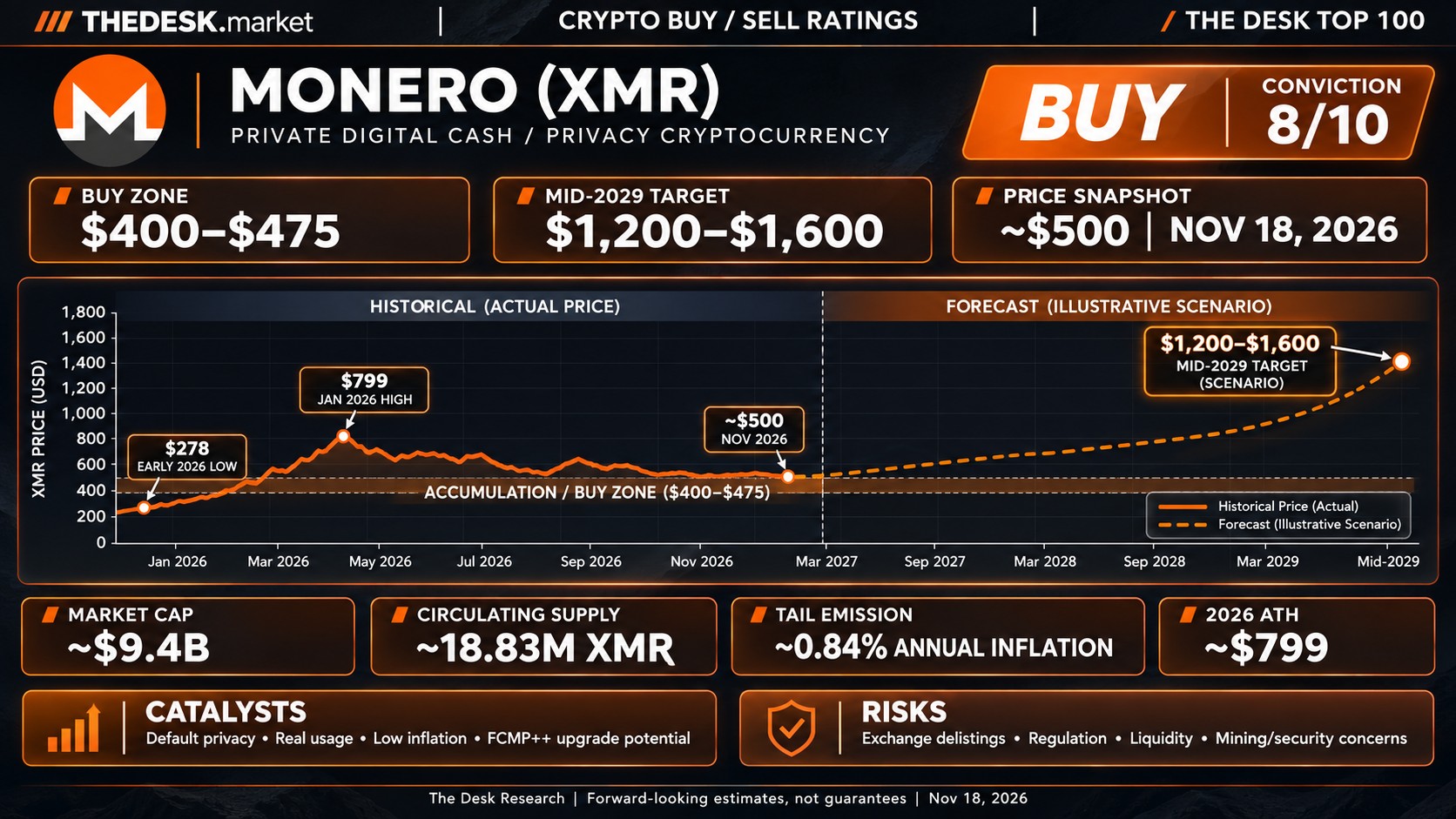
The Desk rates Monero Buy with 8/10 conviction, a $400–$475 preferred accumulation range, and a $1,200–$1,600 mid-2029 scenario target. Default privacy and persistent network use support the thesis, while exchange access and regulation remain major risks.
By The Desk Research · Published
- Rating
- Buy
- Conviction
- 8/10 — editorial confidence, not a probability or guarantee
- Buy zone
- $400–$475
- Long-term target
- $1,200–$1,600
- Target date
- Mid-2029
- Sell signal
- Reassess below $400
Investment Overview: A Distinctive Privacy Network
Monero is a privacy-focused proof-of-work cryptocurrency designed for private digital cash. Its protocol applies privacy protections by default: ring signatures, stealth addresses and confidential transaction amounts help conceal the sender, recipient and value of transfers while allowing the network to validate them.
The Desk's investment thesis is that privacy can become more valuable as payments, savings and business activity move onto public digital networks. Monero's established identity and default-private design differentiate it from transparent blockchains and from systems where privacy is optional.
The supplied research snapshot places XMR near $500 on November 18, 2026, with an approximate $9.4 billion market capitalization and 18.83 million XMR circulating. The Desk rates Monero Buy with 8/10 conviction, a $400–$475 preferred accumulation zone and a $1,200–$1,600 mid-2029 scenario target.
The case is not without substantial constraints. Mandatory privacy can make exchange compliance and institutional access more difficult, while liquidity varies by venue. The Desk's rating reflects both the differentiated utility and the growing risk that investors may find XMR harder to buy, sell or hold through mainstream services.
Default Privacy and Practical Network Use
Monero's privacy model is central to the asset's use case. Transaction details are not exposed on a public ledger in the same way as on transparent chains, which may better suit people and organizations that do not want balances and payment histories visible to anyone.
The supplied analysis reports approximately 33,000 Monero transactions on November 18, 2026. This is a one-day on-chain transaction count, not a measure of unique users, payment value or economic activity; Monero's privacy design also limits how much transfer volume outside observers can independently verify.
The attachment compares Monero with Zcash: Monero makes privacy the default, while Zcash supports optional shielded transactions. This difference gives Monero a clear private-cash profile, but can also create more regulatory friction and fewer routes to exchange access.
A lasting investment case requires everyday usability, reliable wallets and continued network security. Privacy must be useful in practice, not only a feature that differentiates the protocol.
Supply, Tail Emission and Mining
Monero has no fixed maximum supply. After its main emission schedule, the protocol continues a tail emission that the supplied research estimates at approximately 157,680 XMR per year. Against reported circulation of about 18.83 million XMR, that corresponds to roughly 0.84% annual inflation as of the November 18, 2026 snapshot. The percentage declines gradually as the supply base grows.
Unlike many newer tokens, Monero did not launch through an initial coin offering or premine, and its token schedule does not include the large venture-capital unlock cliffs common to some projects. The ongoing emission is intentional: it provides a continuing block reward for miners and avoids relying entirely on transaction fees for long-term network security.
Monero uses RandomX proof-of-work, which is designed to be practical on general-purpose computer hardware and to resist mining dominated by specialized equipment. This design supports a decentralization goal, but does not remove mining concentration, reorganization or other security risks.
Protocol Development and Potential Catalysts
The supplied analysis identifies FCMP++ and Carrot as proposed privacy and address-system improvements. As of the report's November 2026 snapshot, they were still undergoing stressnet testing rather than running on mainnet. A successful implementation could improve privacy properties and address design, but deployment, performance and security reviews remain important prerequisites.
Development progress could strengthen Monero's technical position if upgrades are thoroughly tested and delivered without compromising reliability. The roadmap is a potential catalyst, not a guarantee of a release date, adoption or higher token value.
Other potential catalysts include continuing use of private digital cash, demand for financial confidentiality, low percentage inflation and renewed interest in privacy-focused assets. Those factors would need to outweigh regulatory pressure and the loss of access to major trading venues.
The $400–$475 Accumulation Zone
The Desk prefers accumulation between $400 and $475. The supplied price history shows an early-2026 low near $278, a January high near $799 and a November 18 reference near $500. These are historical snapshots from the attached research, not live quotes.
The analysis places the 200-day moving average near $441 and estimates retracement references around $477 and $389. Together, these levels inform the preferred range, but technical indicators are not reliable guarantees of support or a future reversal.
A gradual approach within the range may reduce the pressure to select one exact entry price. The report identifies a sustained decline below $750 as a reason to reassess the technical outlook, and a break below $600 as a sign that demand may be deteriorating more materially. These are review levels, not automatic sell orders.
At the $400–$475 accumulation range, the $1,200–$1,600 target represents roughly 2.5x–4x price multiples before fees, taxes or changing assumptions. The potential return is speculative and comes with the possibility of significant losses.
Mid-2029 Price Scenarios
The Desk's bullish target is $1,200–$1,600 by mid-2029. The scenario assumes privacy becomes a more important digital-asset use case, Monero retains meaningful network activity, technical upgrades advance successfully, and the market continues to value scarce assets with practical utility.
The supplied analysis outlines a bear scenario of $250–$450 if exchange access worsens and adoption weakens; a moderate scenario of $700–$1,000 with steady privacy demand; the Desk target of $1,200–$1,600 if private digital cash is repriced; and an exceptional $1,800–$2,200+ case if privacy demand accelerates globally.
Assuming continued tail emission, the report estimates a $23–$31 billion market capitalization at $1,200–$1,600 by mid-2029. That is an ambitious increase from the approximately $9.4 billion snapshot and depends on significant demand growth. The scenarios are editorial projections, not consensus forecasts or promised outcomes.
Risks: Access, Regulation and Mining Security
Monero's mandatory privacy creates its central investment tension: the feature may be valuable to users while making exchanges and regulated intermediaries less willing to support the asset. The supplied analysis cites Binance's 2024 spot delisting, Kraken's removal of XMR for European Economic Area customers, and MEXC's announced spot and derivatives delistings in November 2026. Reduced availability can weaken liquidity and limit access for investors.
Mining security is another concern. The report describes Qubic's 2025 mining campaign and unusual chain reorganizations. It cites a 2026 peer-reviewed study that found elevated orphaned blocks and deeper reorganizations but did not establish sustained majority control. The episode highlights the need to monitor hash-rate concentration and network recovery behavior.
Monero's tail emission means supply continues to grow, even though the annual inflation rate is low and gradually declines. Because transaction amounts are private, external analysts also cannot measure the network's economic transfer volume as readily as they can on transparent chains.
Price volatility, exchange access, regulatory action, liquidity, mining concentration and implementation risk for future upgrades could all undermine the thesis. Monero may retain utility while XMR becomes more difficult to trade through familiar venues.
The Bottom Line
Monero has a focused proposition: private digital cash with transaction privacy enabled by default, a long operating history, no premine and a low but continuing tail emission. The supplied transaction-count snapshot provides evidence of ongoing network use, while FCMP++ and Carrot represent possible future improvements if they are successfully tested and deployed.
The main concern is access. Exchange delistings, regulatory uncertainty and uneven liquidity can limit the audience for XMR and create sharp price dislocations. Mining-security events and the inability to independently measure transaction values add further uncertainty.
The Desk rates Monero Buy with 8/10 conviction, prefers a $400–$475 accumulation zone and sets a $1,200–$1,600 mid-2029 scenario target. This is an editorial view based on the supplied research—not individualized investment advice, a guarantee or an instruction to trade.
Key risks
- Mandatory privacy has contributed to exchange delistings and can limit liquidity, accessibility and institutional adoption.
- Privacy-asset regulation could change access to exchanges or other financial services.
- The supplied research describes a 2025 mining campaign and chain reorganizations; it says a 2026 study did not establish sustained majority control.
- Tail emission continues indefinitely; Monero does not have a fixed maximum supply.
- Privacy prevents outside observers from measuring transaction amounts and aggregate economic transfer value as easily as on transparent chains.
- FCMP++ and Carrot were still in stressnet testing in the supplied November 2026 snapshot; successful mainnet deployment is not assured.
- XMR is volatile, and the $1,200–$1,600 target requires meaningful demand growth.
What would change our view
- Reassess if exchange access declines further or liquidity becomes materially weaker.
- Review the thesis after any material mining reorganization, hash-rate concentration or network-security incident.
- Track FCMP++ and Carrot testing, audits and deployment status; do not treat roadmap milestones as completed before release.
- Review the accumulation range if XMR sustains a move below $400, and reassess technical conditions after the report's $750 and $600 levels.
- Revisit the target if adoption, transaction counts, regulation or the tail-emission assumptions materially change.
XMR creators & analysts to follow
Independent third-party commentary. The Desk does not endorse individual creators or their views.
YouTube
X
Rating history
- — Buy, 8/10. Initial coverage. Preferred accumulation range $400–$475; $1,200–$1,600 mid-2029 scenario target.
Editorial opinion, not personalised investment advice. Price targets are forecasts and may not be reached.