Hyperliquid (HYPE) — Buy: $225–$275+ Mid-2029 Target
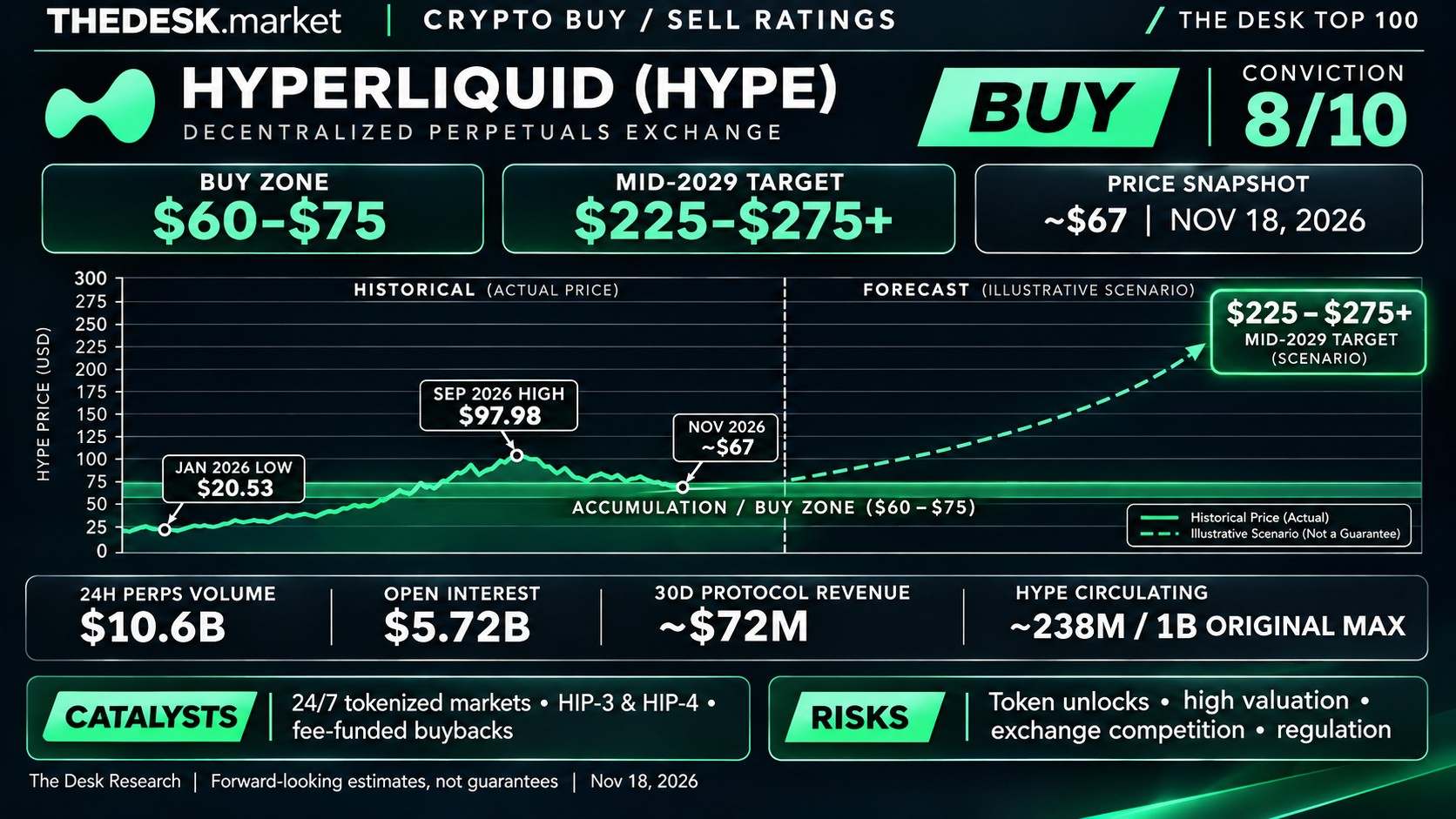
The Desk rates HYPE Buy with 8/10 conviction, a $60–$75 preferred accumulation range, and a $225–$275+ mid-2029 scenario target. The thesis depends on continued trading growth and token demand keeping pace with future supply.
By The Desk Research · Published
- Rating
- Buy
- Conviction
- 8/10 — editorial confidence, not a probability or guarantee
- Buy zone
- $60–$75
- Long-term target
- $225–$275+
- Target date
- Mid-2029
- Sell signal
- Reassess the thesis below $60
Investment Overview: A Trading Network With Real Activity
Hyperliquid brings together a high-performance Layer 1 blockchain, an on-chain order-book exchange for perpetual futures, and an ecosystem of financial applications. Its investment case is more grounded in operating activity than projects that rely mainly on a future product promise: the supplied research describes billions of dollars in daily trading and substantial protocol revenue.
The November 18, 2026 research snapshot lists $10.61 billion in 24-hour perpetuals volume, $5.72 billion in open interest, $72.2 million in 30-day protocol revenue and $680.6 million in revenue over 12 months. It estimates that Hyperliquid represented about 51% of tracked on-chain perpetuals volume and 55% of open interest. These are dated figures from the supplied research, not live metrics, and providers may calculate them differently.
The Desk rates HYPE Buy with 8/10 conviction and prefers accumulation between $60 and $75. The supplied reference price was approximately $67 on November 18, 2026. Our $225–$275+ target for mid-2029 depends on Hyperliquid keeping its derivatives business strong while broadening into more financial markets.
The opportunity is meaningful, but HYPE remains a high-risk crypto asset. Competition, token unlocks, valuation, regulation and the possibility that activity does not translate into lasting token demand are central parts of this thesis.
Why Hyperliquid Stands Out in On-Chain Perpetuals
Hyperliquid's core venue uses an on-chain order book designed for fast execution and deep liquidity. According to the supplied November 18 snapshot, it held approximately 51% of trading volume and 55% of open interest among the on-chain perpetual exchanges tracked in that research.
This position gives the network a substantial base of traders and liquidity, which can help attract more markets and users. However, market share is not permanent. Aster, Lighter, Variational and centralized exchanges are competing for the same traders through pricing, incentives, execution quality and product design.
Trading revenue can also fluctuate with market volatility and user participation. A quiet or declining market may reduce fees and therefore the purchases associated with the Assistance Fund. Today's volume leadership supports the thesis, but continued activity is needed to sustain it.
HIP-3 and the Expansion Beyond Crypto
Hyperliquid's opportunity extends beyond Bitcoin and other digital assets. Through HIP-3, independent developers and market operators can launch perpetual markets tracking instruments such as stocks, commodities, and financial indices. These are derivative products; they do not provide ownership of the underlying securities or commodities.
The supplied research says HIP-3 markets represented roughly 35% of Hyperliquid's trading volume in the seven days ending November 17, 2026. If that activity persists, it could diversify the business beyond crypto-market cycles and expand the range of users and use cases.
Institutional initiatives involving Intercontinental Exchange and Payward, Kraken's parent company, are cited in the supplied material as signs of interest in infrastructure connected to Hyperliquid. Announcements and explorations are not the same as regulatory approval, launched products, adoption or revenue, so the Desk treats them as potential catalysts rather than established outcomes.
HIP-4 could add outcome-based markets, event contracts and other derivatives structures. Its importance is the possibility of a more diversified trading ecosystem, but the products still need to attract durable users and operate within applicable rules.
Revenue, HYPE Purchases and Token Economics
The supplied research describes eligible protocol fees flowing to the Assistance Fund, which purchases HYPE, alongside burns connected with a portion of economic activity. It reports approximately $72.2 million in HYPE purchases over the preceding 30 days and $680.6 million over 12 months in its November 18 snapshot.
These purchases may connect growth in platform activity with token demand. They are not dividends, a claim on company earnings, or direct equity ownership. The effect on price also depends on circulating supply, the pace of new distributions, market conditions and whether the mechanism continues as described.
HYPE launched in November 2024 with an original maximum allocation of one billion tokens. The supplied distribution table assigns 38.89% to future community emissions and rewards, 31% to the genesis distribution, 23.8% to core contributors, 6% to the Hyper Foundation, 0.3% to community grants and approximately 0.01% to HIP-2 liquidity. About 238 million tokens were classified as circulating in the November 2026 snapshot; subsequent burns have reduced the original maximum.
Future emissions and contributor allocations may increase circulating supply. Scheduled unlocks do not necessarily mean recipients will sell, but they can create potential supply pressure. The key question is whether durable token demand and burns can keep pace with effective new supply. That uncertainty is one reason conviction is 8/10 rather than 9/10 or 10/10.
The $60–$75 Accumulation Range
The Desk's preferred buy zone is $60–$75. HYPE reached approximately $98 in September 2026 before pulling back; the supplied November 18 reference price near $67 was inside our preferred range.
This range is a valuation-conscious accumulation area, not guaranteed technical support. A phased approach may reduce reliance on choosing one exact entry price, but it cannot eliminate the possibility of losses or further declines.
A move below $60 should trigger a review of the thesis rather than an automatic sell instruction. A lower price could be more attractive only if the operating picture remains healthy; if revenue, competitive position or token economics weaken, the original buy case may no longer hold.
Mid-2029 Price Scenarios
The Desk's target is $225–$275+ by mid-2029. It assumes Hyperliquid maintains a leading position in on-chain derivatives, grows financial-market activity and protocol revenue, and generates enough durable HYPE demand to offset increasing supply.
The supplied report frames a bear case of $50–$100 if competition intensifies, trading activity declines or unlocks create persistent pressure. The central Desk scenario is $225–$275+ if the derivatives business strengthens, new financial markets find users and demand grows. An exceptional bull case of $300–$400+ would require unusually strong global adoption and is highly speculative.
At 400 million circulating HYPE, the $225–$275 range implies about $90–$110 billion in circulating market capitalization; at 500 million tokens, it implies about $112.5–$137.5 billion. These illustrations show the scale of growth the target requires. Supply may differ by 2029, and the target is an editorial forecast, not a valuation guarantee or promised return.
Risks That Could Break the Thesis
Token unlocks and future community emissions could expand circulation faster than purchases and burns absorb it. Hyperliquid already carries high growth expectations, so even a strong operating business may underperform if the market has priced in too much future success.
Competition from other decentralized venues and centralized exchanges could pressure fees, liquidity, incentives and market share. The platform's trading activity and revenue are also sensitive to crypto-market cycles and may contract in prolonged low-volatility periods.
Perpetual derivatives, prediction markets and tokenized financial products face regulatory uncertainty. Restrictions in major markets could limit product availability or growth. Validator concentration, governance arrangements and unusual trading incidents described in the supplied research also raise decentralization and market-risk-control questions.
The thesis would weaken if trading volumes and revenue fall materially, if HIP-3 or other new markets fail to retain activity, if effective token supply grows faster than demand, or if competition erodes Hyperliquid's position.
The Bottom Line
Hyperliquid has built a sizable on-chain derivatives business and is extending its market design toward stocks, commodities, indices and event-based products. Meaningful trading activity, protocol revenue and a fee-linked HYPE purchase mechanism give the token a clearer operating thesis than a purely narrative-driven asset.
The counterweight is substantial: future supply growth, aggressive valuation expectations, competition, regulation and uncertain durability of token demand. The supplied ~$67 price is a November 18, 2026 snapshot, not a current quote.
The Desk's rating is Buy with 8/10 conviction, a $60–$75 preferred accumulation range and a $225–$275+ mid-2029 scenario target. Those figures express an editorial thesis, not individualized investment advice, a guaranteed return or an instruction to place a trade.
Key risks
- Future community emissions and core-contributor unlocks could outpace demand and create dilution or selling pressure.
- The target implies a very large future market capitalization and requires exceptional execution and continued investor confidence.
- Aster, Lighter, Variational and centralized exchanges compete for traders, liquidity and fee revenue.
- Protocol revenue, token purchases and trading volume can decline during low-volatility or weak-market periods.
- Perpetual derivatives, prediction markets and tokenized financial products face regulatory uncertainty across major jurisdictions.
- Validator concentration, governance design and past market-risk incidents create decentralization and operational concerns.
- The $225–$275+ target is a scenario, not a forecast guarantee; HYPE can lose substantial value.
What would change our view
- Review the thesis if HYPE sustains a move below $60, while distinguishing a lower price from a change in business fundamentals.
- Track whether protocol revenue and Assistance Fund purchases remain durable relative to new effective token supply and unlocks.
- Reassess if on-chain derivatives market share, liquidity or user activity decline materially.
- Review HIP-3 and HIP-4 adoption and any regulatory changes affecting derivatives, event markets or tokenized financial products.
HYPE creators & analysts to follow
Independent third-party commentary. The Desk does not endorse individual creators or their views.
YouTube
X
Rating history
- — Buy, 8/10. Initial coverage. Preferred accumulation range $60–$75; $225–$275+ mid-2029 scenario target.
Editorial opinion, not personalised investment advice. Price targets are forecasts and may not be reached.