Chainlink (LINK) — Buy: Critical Financial Infrastructure, but Tokenomics Limit the Upside
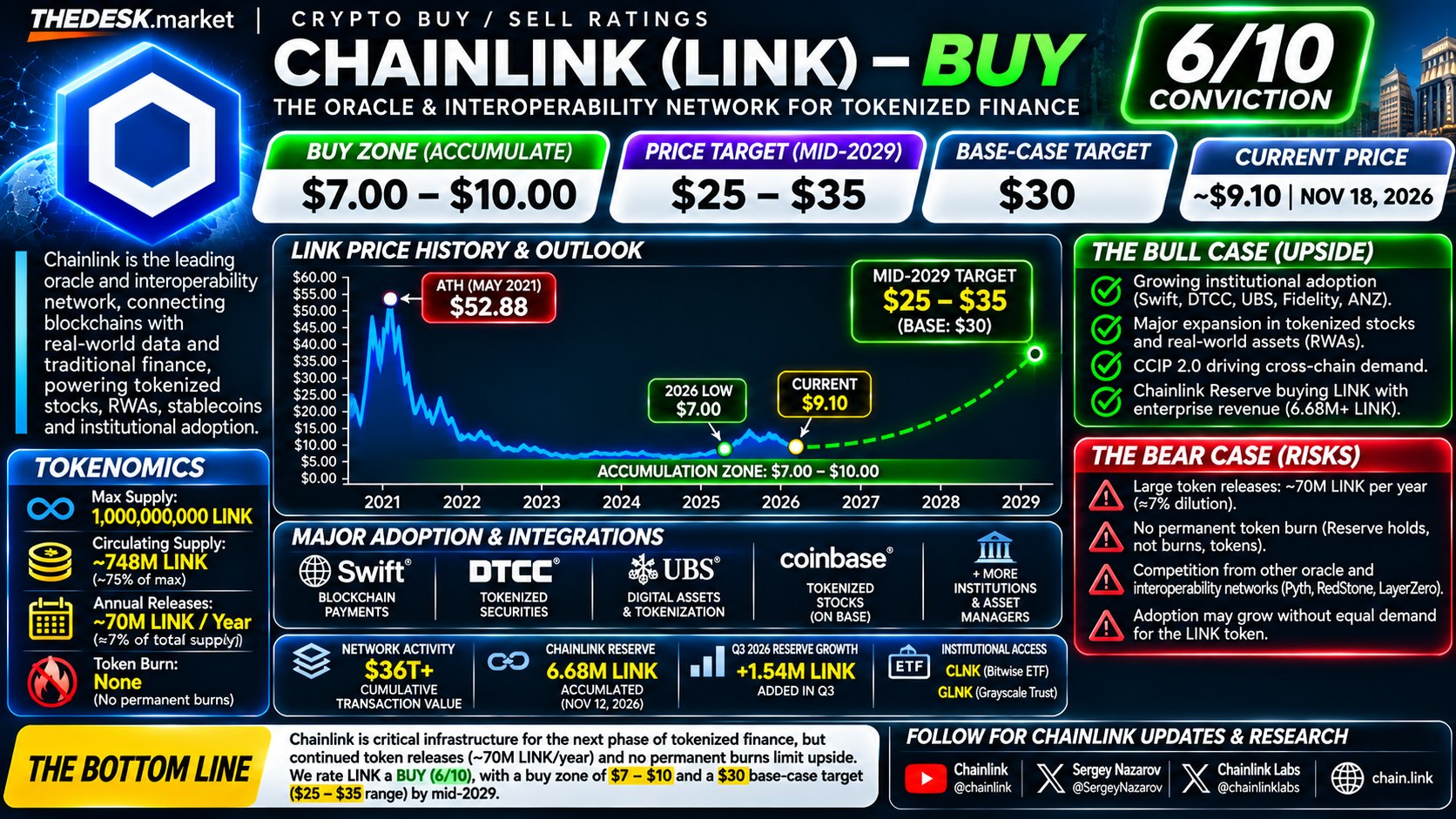
The Desk rates LINK Buy with 6/10 conviction, favoring accumulation at $7–$10 and setting a $25–$35 mid-2029 scenario target, with $30 as the base case. Chainlink’s expanding role in data and cross-chain infrastructure is constructive, while circulating-supply growth and uncertain token value capture temper the outlook.
By The Desk Research · Published
- Rating
- Buy
- Conviction
- 6/10 — editorial confidence, not a probability or guarantee
- Buy zone
- $7.00–$10.00
- Long-term target
- $25–$35
- Target date
- Mid-2029
- Sell signal
- Reassess below $7.00
Investment Outlook: Infrastructure With a Separate Token-Value Question
Chainlink has become a prominent infrastructure provider in digital assets, connecting blockchain applications to external data and enabling communication across different networks. Its opportunity is broader than the prospects of any single blockchain: oracle services, cross-chain messaging and institutional tools can support activity on Ethereum, Solana, BNB Chain and other systems.
That breadth is relevant as financial firms explore tokenized securities, funds, stablecoins and other real-world assets. Onchain issuance alone is not enough; applications also need reliable data, proof of reserves, settlement coordination and ways to move assets between networks. Chainlink is building products for several of these requirements.
The investment case for LINK nevertheless has two distinct parts: whether Chainlink technology is adopted, and whether that adoption creates durable demand or value capture for the token. The first has advanced; the second remains less certain. The supplied research places LINK near $9.10 on November 18, 2026, roughly 83% below its May 2021 high of $52.88.
The Desk rates LINK Buy with 6/10 conviction. The preferred accumulation zone is $7–$10, and the mid-2029 scenario target is $25–$35, with $30 as the base case. The rating reflects meaningful infrastructure potential balanced against token releases, competition and an incomplete link between network activity and token-holder economics.
Oracle and Cross-Chain Products Address Real Infrastructure Needs
Decentralized oracle networks bring external information—such as market prices or reserve data—into smart contracts. That function is important for lending, derivatives, stablecoins and other applications where an incorrect or unavailable data feed can create financial losses.
Chainlink’s Cross-Chain Interoperability Protocol, or CCIP, is designed to let applications and institutions exchange messages and transfer assets across blockchain networks. Its Chainlink Runtime Environment provides tools for coordinating processes that involve onchain contracts and traditional systems.
These capabilities could become more valuable if tokenized financial products operate across several chains rather than within a single closed network. Banks, asset managers and market infrastructure providers may need controls around permissions, identity, settlement and compliance in addition to basic asset transfers.
The supplied research describes work involving Swift, DTCC, UBS, Fidelity International, ANZ and other institutions. These relationships and demonstrations support the case that Chainlink is being evaluated beyond crypto-native applications. They should not be read as proof that every pilot is a commercial deployment, or that any institution has committed to buy LINK.
Adoption Is Meaningful, but Activity Is Not the Same as Revenue
The supplied October 2026 network report cites more than $36 trillion in cumulative transaction value facilitated by Chainlink services. That figure illustrates the scale of activity connected to the network, but it is not revenue earned by Chainlink, funds invested in LINK or value accruing directly to token holders.
This distinction matters to the valuation. A service can underpin large transaction flows while collecting only a small fee relative to the activity it supports. The long-term question is whether expanding oracle and cross-chain use generates enough recurring commercial revenue, reserve purchases or direct utility to support a larger token valuation.
The Chainlink Reserve creates a more explicit connection between service revenue and LINK demand. Under the supplied research, the Reserve held approximately 6.68 million LINK by November 12, 2026, including about 1.54 million added during the third quarter. Those purchases are constructive, but they do not remove tokens from existence: the Reserve holds LINK rather than permanently burning it.
The same research estimates scheduled releases of roughly 70 million LINK per year. Reserve holdings therefore remain much smaller than the amount that could enter circulation in a year. If commercial revenue and reserve accumulation grow substantially, that comparison may improve; the base-case target does not assume the Reserve will offset all releases.
Tokenomics: Fixed Maximum Supply, Expanding Circulation
LINK has a maximum supply of one billion tokens, all created at launch. That means the token does not have an uncapped issuance schedule. However, a meaningful portion of the original allocation has historically remained outside circulating supply and can be released over time for operations, development and ecosystem incentives.
The owner-supplied analysis estimates approximately 748 million LINK in circulation in November 2026 and cites an annual release schedule near 70 million tokens, equivalent to about 7% of maximum supply. Circulating-supply estimates differ among data providers, and planned releases do not necessarily mean every token is sold immediately. They still represent potential supply that market demand must absorb.
The distinction is between maximum-supply inflation and circulating-supply dilution. LINK’s maximum is fixed, but the amount available in the market can continue to rise. The project has no permanent token-burning program in the supplied analysis. That limits a simple scarcity-based argument, even as the Reserve provides a possible source of revenue-funded purchases.
The research also notes that the Reserve’s holdings are not a burn and could potentially be used or released in the future. Investors should not equate tokens held in a treasury with tokens permanently removed from supply.
Competition and Institutional Adoption Risks
Chainlink competes in oracle services with providers including Pyth Network, RedStone and API3, and in interoperability with projects such as LayerZero. Institutions may use multiple providers, build proprietary systems or select different vendors for different applications. A strong current position does not ensure that Chainlink will retain market share.
Adoption may also take longer than the market expects. Financial institutions operate under security, privacy, operational and regulatory constraints, and a successful proof of concept does not guarantee scaled production use. Tokenized markets could expand while generating less Chainlink revenue or LINK demand than anticipated.
Exchange-traded products can make LINK easier to access through traditional brokerage accounts. The supplied report says Bitwise and Grayscale products together held approximately 16.65 million LINK at the end of the third quarter of 2026. Product availability is a positive distribution channel, but assets held and future inflows matter more than a listing alone; ETF access does not guarantee sustained investor demand.
The central risk remains a gap between the importance of Chainlink’s technology and the economic value captured by LINK. The network may succeed as infrastructure without the token appreciating in proportion to usage.
Accumulation Zone: $7–$10
The Desk prefers gradual accumulation between $7 and $10. The supplied historical snapshot shows LINK trading near $7 during June 2026, recovering toward $15.77 in September, then returning to approximately $9.10 on November 18. The range is an editorial entry preference based on the supplied research, not a guaranteed technical floor.
A staged approach reduces the risk of committing at one price in a volatile market. A decisive break below $7 would weaken the current thesis and prompt a review of market conditions, token releases, network revenue and adoption rather than an automatic buy or sell instruction.
The report also notes LINK was below its 200-day moving average in November 2026. A sustained recovery above that indicator could support a stronger momentum assessment, but moving averages are not reliable guarantees of future direction.
Mid-2029 Outlook: $25–$35, With a $30 Base Case
The Desk’s mid-2029 scenario range is $25–$35, with $30 as the base case. The forecast assumes Chainlink remains a leading oracle and interoperability provider, expands enterprise deployments, and benefits from growth in tokenized assets and cross-chain settlement. It also assumes circulating supply continues to increase and that Reserve purchases do not fully offset releases.
At the supplied estimated circulating range of 930–950 million LINK by mid-2029, a $30 token price would imply approximately $27.9–$28.5 billion in circulating market capitalization. The $25–$35 range implies approximately $23.3–$33.3 billion. These are scenario calculations, not forecasts of realized returns.
A more bullish outcome could require larger commercial deployments, stronger recurring revenue, broad use of CCIP, greater institutional investment and materially higher Reserve purchases. Continued dilution, limited revenue conversion, competition or slower adoption could instead leave LINK below the target range.
The $30 base case is intentionally below the prior $52.88 high. It reflects the view that infrastructure adoption can support recovery, while supply releases and uncertain token value capture may constrain valuation.
The Bottom Line
Chainlink is positioned in important areas of financial-market infrastructure: data services, cross-chain communication and tools that connect traditional systems with blockchain applications. Institutional research and product development support the possibility of wider adoption, particularly if tokenized securities and other real-world assets scale across networks.
LINK’s investment case is more qualified than the technology story alone suggests. Circulating supply is still growing, the Reserve is not a burn mechanism, and network activity does not automatically translate into proportional token demand. Competing providers and the pace of institutional deployment also remain important uncertainties.
The Desk rates LINK Buy with 6/10 conviction, prefers accumulation between $7 and $10, and sets a $25–$35 mid-2029 scenario target with $30 as the base case. The rating and price ranges are editorial opinions, not personalized investment advice or guaranteed outcomes.
Key risks
- Circulating-supply releases may add roughly 70 million LINK annually under the supplied estimate, creating potential dilution and selling pressure.
- The Chainlink Reserve holds LINK rather than permanently burning it; current holdings are much smaller than estimated annual token releases.
- Network activity and cumulative transaction value are not equivalent to protocol revenue or value accruing to LINK holders.
- Institutional pilots and partnerships may not become scaled commercial deployments or generate meaningful token demand.
- Oracle and interoperability competitors may win market share or reduce pricing power.
- Tokenized-asset adoption may take longer or produce less revenue than the current thesis assumes.
- The $7–$10 accumulation zone and $25–$35 target are uncertain editorial scenarios; LINK can trade below or above either range.
What would change our view
- Reassess if LINK decisively breaks below $7 or if the broader market changes the assumptions behind the accumulation zone.
- Track circulating supply and scheduled releases against actual revenue-funded LINK purchases by the Chainlink Reserve.
- Review whether institutional pilots involving Swift, DTCC and other firms progress into sustained production deployments.
- Monitor usage, fee generation and revenue conversion separately from cumulative transaction value secured or facilitated.
- Revisit the target if CCIP adoption, tokenized-finance demand, competition or institutional investment materially diverges from the current thesis.
LINK creators & analysts to follow
Independent third-party commentary. The Desk does not endorse individual creators or their views.
YouTube
X
Rating history
- — Buy, 6/10. Initial coverage. Preferred accumulation range $7–$10; $25–$35 mid-2029 target, with $30 base case.
Editorial opinion, not personalised investment advice. Price targets are forecasts and may not be reached.