Cardano (ADA) — Strong Sell: Adoption and Ecosystem Risks Weigh on the Outlook
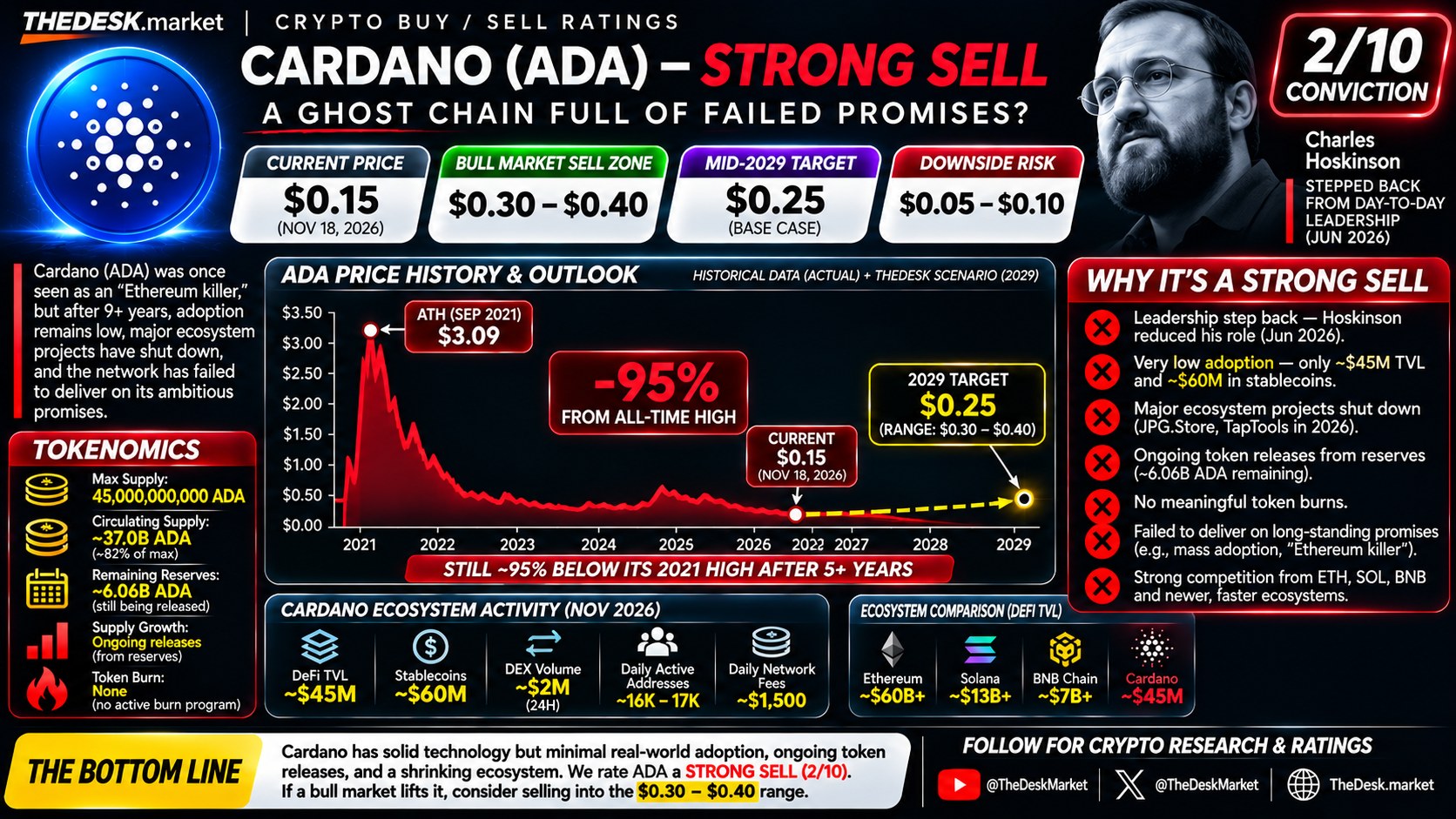
The Desk rates ADA Strong Sell with 2/10 conviction. Cardano remains operational and continues developing, but the supplied November 2026 research shows modest DeFi activity and liquidity relative to its valuation. The base-case mid-2029 target is $0.25, with a possible $0.30–$0.40 bull-market sell zone and a $0.05–$0.10 downside scenario.
By The Desk Research · Published
- Rating
- Strong Sell
- Conviction
- 2/10 — editorial confidence, not a probability or guarantee
- Buy zone
- NONE
- Long-term target
- $0.25 base case
- Target date
- Mid-2029
- Sell signal
- Reduce or exit; $0.30–$0.40 rebound sell zone
Investment Outlook: Development Has Not Yet Produced Broad Adoption
Cardano entered the market as a research-led proof-of-stake blockchain with ambitions in smart contracts, decentralized finance and global financial services. It has delivered major technical milestones, including staking, smart contracts and decentralized governance. The investment question is whether those capabilities have attracted enough durable economic activity to support ADA’s valuation.
The research supplied for this rating describes a marked gap between the network’s market value and its onchain financial activity. As of November 2026, it estimates about $45 million in DeFi total value locked, approximately $60 million in stablecoin supply, roughly $2 million in daily decentralized-exchange volume and around 16,000–17,000 daily active addresses. These are time-specific estimates and may vary by data provider and methodology.
Cardano is not inactive, and the figures do not establish that the network has no users or applications. They do, however, suggest that its financial ecosystem remains small relative to leading competing networks and to the expectations that once supported ADA’s valuation.
The Desk rates ADA Strong Sell with 2/10 conviction. We do not assign a buy zone at the supplied reference price near $0.15. Our mid-2029 base case is $0.25, while $0.30–$0.40 is a possible speculative bull-market sell zone. The rating reflects opportunity cost and adoption risk, not a prediction that Cardano will shut down.
Network Activity Is the Central Investment Test
Blockchain valuations ultimately depend on whether users and developers choose to transact, build applications and keep capital on the network. A protocol can have technically distinctive features and a loyal community while still struggling to create a deep financial marketplace.
The supplied snapshot’s estimates for DeFi deposits, stablecoins, trading volume and fees are modest compared with activity reported on Ethereum, Solana and BNB Chain. Deeper liquidity can attract more traders and developers, while a smaller pool of assets and users can make it harder for new applications to gain traction.
Comparisons between chains are imperfect. Networks differ in design, reporting conventions, transaction costs and the kinds of applications they prioritize. Even so, sustained growth in stablecoin balances, DeFi deposits, exchange volume, recurring users and fee generation would be important evidence that Cardano is closing the adoption gap.
Until that improvement is visible in durable data, the Desk is reluctant to value ADA primarily on future possibilities. The key measure is not whether development continues, but whether the network converts that development into repeat usage and economically meaningful demand.
Ecosystem Closures Raise Execution Questions
The owner-supplied research describes the 2026 closures of JPG.Store and the wind-down of TapTools, alongside a Cardano Summit cancellation after a treasury proposal failed to secure the required approval. These are specific setbacks for the ecosystem and its supporting services, rather than evidence that the Cardano blockchain itself has stopped operating.
Project closures can result from many factors, including revenue, operating costs, leadership changes and strategic decisions. A small number of shutdowns does not by itself establish a broad collapse. Their relevance is that applications, analytics and marketplaces help users discover and participate in a network; repeated losses can make it harder to retain developers and attract new users.
Cardano’s governance model gives stakeholders a role in treasury and protocol decisions. That is a meaningful feature, but disagreements over funding can also delay or prevent ecosystem initiatives. Investors should watch whether governance translates into effective support for useful products, not only the existence of governance mechanisms.
The research also notes founder Charles Hoskinson’s reduced public-facing role in June 2026 and his clarification that he was not resigning or abandoning Cardano. Leadership commentary can influence sentiment, but the longer-term investment test remains the network’s ability to sustain an independent developer and user economy.
Fixed Maximum Supply Does Not Eliminate Dilution
ADA has a stated maximum supply of 45 billion tokens, which limits ultimate issuance. The supplied November 2026 figures estimate about 37 billion ADA circulating and approximately 6.06 billion remaining in protocol reserves in October. Circulating supply can continue to rise as previously allocated reserves are distributed through staking rewards and treasury funding.
This is different from an uncapped supply: Cardano has a maximum, but that maximum has not yet entered circulation. Reserve distribution can increase the amount of ADA available to the market, and the effect on price depends on whether user, staking and investment demand grows quickly enough to absorb it.
The supplied research says Cardano does not have a major permanent burn mechanism. Its economic model instead relies on staking incentives, transaction fees and participation. A fixed cap is a relative positive, but it does not independently create demand or guarantee price appreciation.
For the bearish thesis, token supply is a secondary issue to adoption. Gradual distribution would be more manageable if network activity and demand were expanding rapidly. With modest reported onchain activity, additional circulating tokens may make a recovery more difficult.
Cardano’s Strengths and Potential Catalysts
Cardano continues to operate with a proof-of-stake network, a committed community and onchain governance. Its extended UTXO architecture and research-driven development approach are genuine design choices, and the project has continued work on developer tooling and scaling, including Ouroboros Leios.
The research also notes the February 2026 launch of USDCx using Circle’s xReserve infrastructure, which could broaden access to dollar-backed liquidity. Stablecoin growth would be useful if it supports lasting activity in payments, decentralized exchanges and lending rather than remaining a one-time launch milestone.
These developments provide a path for the thesis to improve. Evidence that would matter includes sustained increases in stablecoin supply, DeFi deposits, daily users, exchange volume, network fees and application retention. Better infrastructure and announcements alone would not be sufficient without measurable adoption.
This is why the rating has 2/10 conviction rather than treating Cardano’s decline as proof of failure. The network can still improve, but the current evidence in the supplied research does not yet justify a more constructive long-term call.
Valuation and Price Scenarios Through Mid-2029
At approximately $0.15 on November 18, 2026, ADA was around 95% below the supplied September 2021 high near $3.09. A large decline can make a token look inexpensive compared with its previous peak, but historical prices do not establish fair value. The earlier valuation reflected different market conditions and expectations.
The Desk’s mid-2029 base case is $0.25. The research also identifies $0.30–$0.40 as a possible bull-market sell zone if speculative demand returns. At an illustrative future circulation of 39 billion ADA, $0.30 would imply roughly $11.7 billion in circulating market capitalization and $0.40 roughly $15.6 billion. These calculations depend on the assumed supply and are not forecasts of realized returns.
The downside scenario is $0.05–$0.10 if network activity remains weak, ecosystem projects continue to close or investor attention shifts elsewhere. This is a scenario rather than a technical support level, and prices can fall below it.
The base case assumes Cardano remains operational and participates in a broader crypto-market recovery without reclaiming its prior speculative leadership. Stronger adoption could produce a better outcome; continued stagnation could leave ADA below the base case. The Desk sees a rebound toward $0.30–$0.40 as a possible opportunity for existing holders to reduce exposure, not as a guaranteed event.
The Bottom Line
Cardano has built real technology, a functioning proof-of-stake network and an active governance community. But the investment case depends on converting those assets into more users, deeper liquidity and recurring economic activity. The supplied November 2026 metrics remain modest relative to the size of the network’s market valuation.
A fixed maximum supply, ongoing development and new stablecoin infrastructure are positives. They are offset by continued reserve distribution, limited reported DeFi and trading activity, ecosystem closures, governance challenges and strong competition from networks with larger financial markets.
The Desk rates ADA Strong Sell with 2/10 conviction, assigns no buy zone, and sets a $0.25 mid-2029 base-case target. A $0.30–$0.40 bull-market rebound is a possible sell zone; $0.05–$0.10 is a downside scenario. All figures are editorial estimates based on the supplied dated research, not personalized investment advice or guaranteed outcomes.
Key risks
- DeFi deposits, stablecoin supply, exchange volume and daily active addresses remain modest in the supplied November 2026 snapshot.
- The network may continue to lag competitors in liquidity, applications, users and economic activity.
- Previously allocated ADA reserves can continue entering circulation despite the 45-billion maximum supply.
- Ecosystem project closures and treasury disputes may weaken developer support and user confidence.
- Scaling work and new stablecoin infrastructure may not translate into sustained usage or token demand.
- A broad cryptocurrency rally may not restore ADA’s prior market leadership or historical high.
- The $0.25 base case, $0.30–$0.40 sell zone and $0.05–$0.10 downside scenario are uncertain; ADA can trade outside these ranges.
What would change our view
- Revisit the rating if stablecoin supply, DeFi deposits, DEX activity, recurring users and network fees show sustained growth.
- Track reserve distributions and circulating supply against demand and staking participation.
- Review whether USDCx, Leios and other ecosystem initiatives produce measurable adoption rather than announcements alone.
- Monitor the health of major applications, developer activity and funding decisions through Cardano governance.
- Reassess the $0.25 mid-2029 base case and $0.30–$0.40 sell zone as market conditions and network data change.
ADA creators & analysts to follow
Independent third-party commentary. The Desk does not endorse individual creators or their views.
YouTube
X
Rating history
- — Strong Sell, 2/10. Initial coverage. No buy zone; $0.25 mid-2029 base case, with $0.30–$0.40 as a possible bull-market sell zone.
Editorial opinion, not personalised investment advice. Price targets are forecasts and may not be reached.