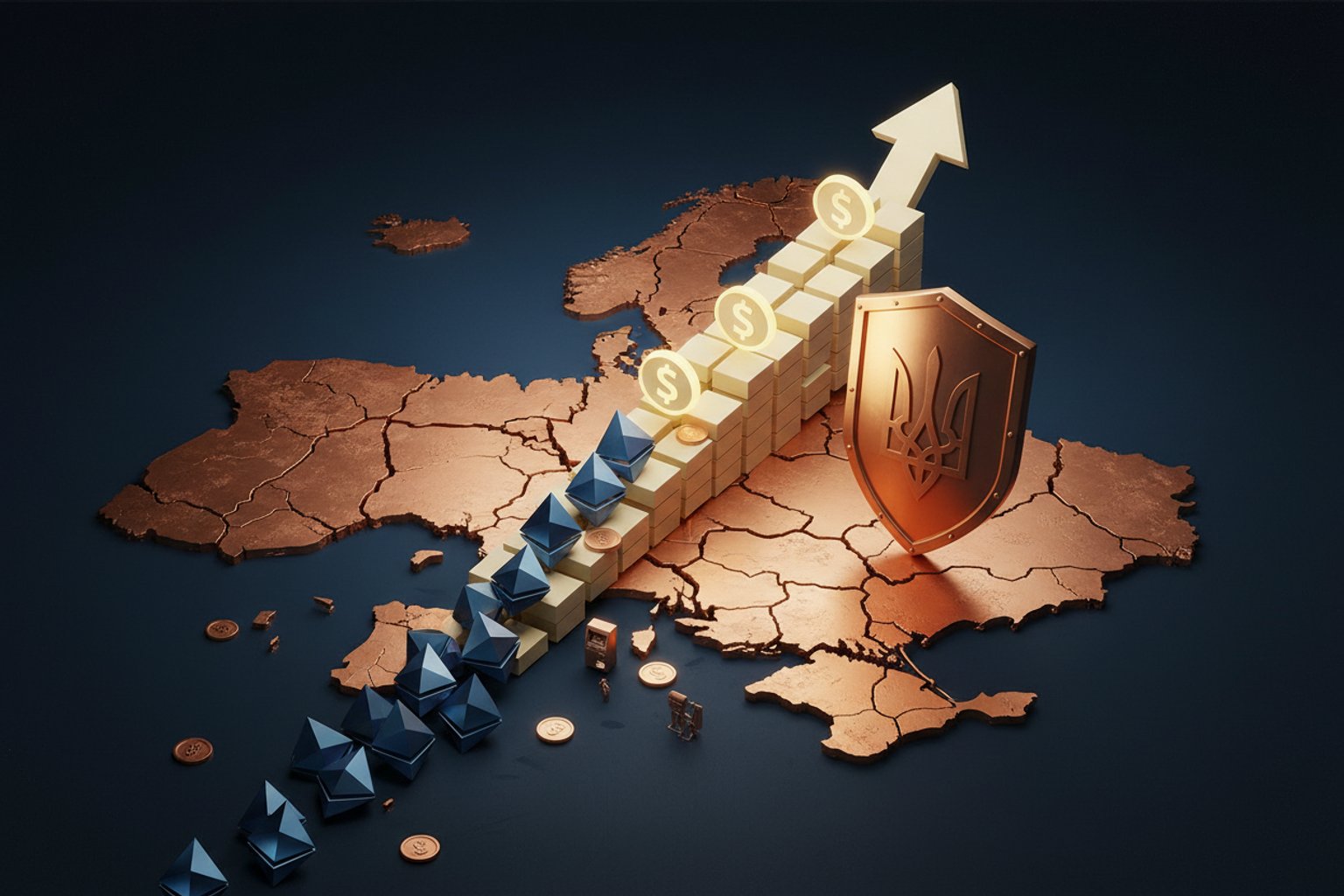
Eastern Europe recorded the largest decline in crypto activity of any region tracked by Chainalysis, even as Ukraine received billions of dollars in cross-border stablecoin transfers during the war. Regional activity fell 7.9% in the 12 months through June 2026, compared with a 1.6% decline globally, Cointelegraph reported November 17. The findings show a market in which large transfers contracted while some smaller-transfer channels continued to grow.
The region’s measured crypto economy declined to $642.1 billion from $697.1 billion a year earlier, a reduction of $55 billion. Those figures represent estimated activity over the respective study periods, not the value of assets held at a particular date. Chainalysis combines inflows to crypto services with domestic transfers between personal wallets and cross-border inflows to personal wallets. Changes in crypto prices can also affect the dollar values in the report.
Large transfers retreat, but the decline varies by country
Russia accounted for about 44% of the regional total, with its measured activity falling 14.7% to $284.1 billion. The regional decline was not shared by every country in the study. Belarus recorded growth of 27.6%, while Bulgaria, Moldova and Ukraine also registered increases, though smaller ones. The contrast matters because the aggregate figure combines markets moving in different directions, including Russia’s substantial share and growth elsewhere in the region.
Transfers of at least $10,000 to crypto services fell 17.4%, to $488.6 billion from $591.5 billion. That measure covers a narrower set of transactions than the overall regional estimate: it tracks transfers to services rather than also counting the specified personal-wallet flows. The contraction in larger transfers therefore offers a view of activity at crypto services, but it should not be treated as the whole change in the regional total.
Smaller transfers to crypto services moved in the opposite direction, increasing 8.3% in value. They made up 13.1% of the value sent to those services in Eastern Europe, compared with 10.1% globally. That was the highest regional share in the study. Together with the decline in larger transfers, the figures point to a change in the mix of activity reaching services, rather than a uniform retreat across transaction sizes.
ATMs and Ukraine’s cross-border flows
Crypto ATMs were another area of growth. Regional transaction volume through the machines rose to $33.9 million from $17.3 million, nearly doubling over the comparison period. The increase stands apart from the broader decline measured across the region, although ATM activity is a much smaller category than the hundreds of billions of dollars captured in the regional estimate. The two figures describe different channels and should not be read as interchangeable measures.
Poland illustrated that divergence within a single market. Its ATM transactions rose 120% while activity on centralized exchanges fell 5%. Stablecoins accounted for roughly 90% of Polish ATM transactions, according to the report. The figures identify a growing use of ATMs alongside a decline at centralized exchanges, without establishing that transactions moved from one channel to the other or explaining the reasons for either change.
Ukraine received $12 billion in cross-border stablecoin transfers between wallets during the study period. Transfers below $10,000 represented $2.41 billion of that amount, or approximately one-fifth. The figures capture transfers rather than the balances held by recipients. They also describe a specific portion of Ukraine’s crypto activity, separate from the regional measure that includes flows to services and certain domestic personal-wallet transfers.
Among 36 countries in Europe and North America examined by Chainalysis, Canada was the largest source of retail-sized, remittance-like transfers to Ukraine, at $359 million. That figure is a subset of smaller transfers, not a measure of all Canadian stablecoin flows to Ukraine. It provides a more specific view of cross-border activity than the $12 billion aggregate, while covering only the countries and transfer category examined for that comparison.
Countries with larger Ukrainian populations generally sent more stablecoins to Ukraine. Those populations included established diaspora communities and refugees who arrived after Russia’s full-scale invasion in February 2022. A Chainalysis spokesperson said the cross-border flows were largely in stablecoins pegged to the US dollar, though the firm did not provide a breakdown by token. The reported relationship with population does not establish why individual transfers were made.